
Pilot · Secure · Scale · Govern
From first pilot to a governed digital workforce.
Gemini Enterprise puts agents to work across your organization. The Gemini Enterprise Agent Platform builds, scales, and governs them. Dito is the Google-dedicated partner that guides both: proving value on a real process first, securing agents like the workers they are, and running the governance when you would rather not build that function yourself.
Google-dedicated since 2007
Tokens processed monthly across Google AI surfaces
Monthly active users of the Gemini app
Google Cloud customers each processing 1T+ tokens a year
Developers building with Google models each month
Platform figures reported by Google, I/O 2026
The agent decision
Chatbots answered questions. Agents do work. That changes what you are accountable for.
A chatbot answers when asked. A workflow follows the script it was given. An agent pursues an outcome: it plans, calls tools, acts across your systems, and decides what to do next. That third category is where the productivity is. It is also where the accountability lives, and it puts three decisions in front of most leadership teams before a specialist is in the room:
The platform is moving faster than your review cycle.
In April 2026, Vertex AI evolved into the Gemini Enterprise Agent Platform. Weeks later, I/O brought Antigravity 2.0, Managed Agents in the Gemini API, and Gemini 3.5 Flash. Waiting for the picture to settle is not a strategy. The picture does not settle.
Everyone in your company can now build an agent.
Agent Designer lets any employee create agents in natural language. That is the point of an agentic workplace, and it is also how you get shadow AI at machine speed: agents without owners, identities, or boundaries. The answer is not to slow your people down. It is to govern what they build.
The governance question arrives with the first production agent.
Boards, auditors, and regulators will ask the same three things: who authorized this agent, what data did it touch, and why did it act? The controls exist on the platform. Someone has to design them, operate them, and answer for them.
The distinction that runs through this page: chatbots respond, workflows execute, agents decide. Each step up multiplies the value and the need for governance. Dito’s practice is built for the third step.
The platform
One agentic stack, from silicon to your workforce.
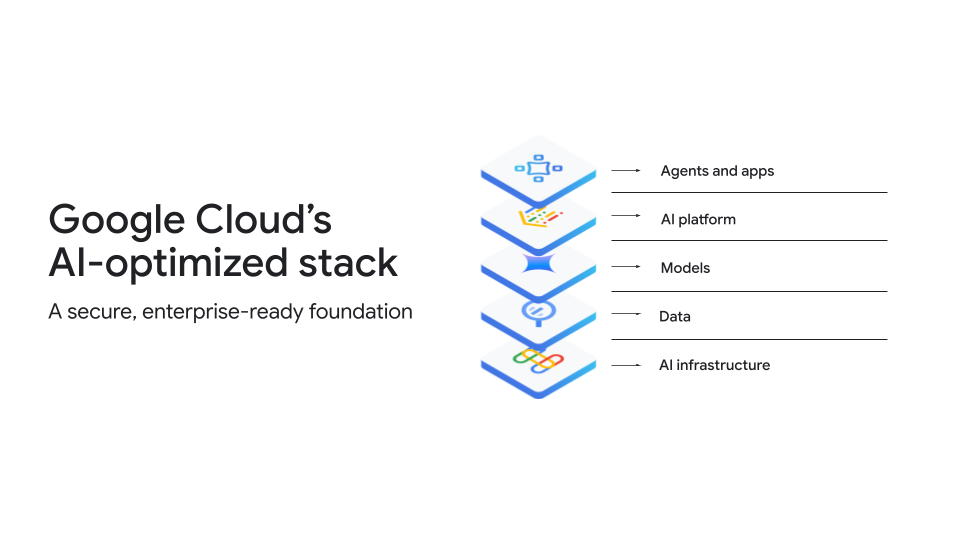
Google is the only provider that owns the entire stack: custom TPUs and infrastructure, frontier models, the platform that runs agents, and the workspace where employees put them to work.
Dito helps you compose the right pieces for your organization, then keeps the composition secure and efficient as adoption grows.
The workplace
Gemini Enterprise
The agentic platform where your workforce creates, runs, and supervises agents. Agent Designer builds agents from natural language, no code required. The Inbox manages long-running agents and routes approvals to humans before consequential actions. Canvas co-creates documents and presentations, with interoperability for Microsoft 365 formats. Skills and Projects make agent knowledge reusable and work persistent.
8M+ paid seats across 2,800+ companies, as reported by Google
The factory
Gemini Enterprise Agent Platform
The evolution of Gemini Enterprise Agent Platform: one environment to build, scale, govern, and optimize agents across their whole lifecycle. Build with the Agent Development Kit or any open-source framework. Deploy on Agent Engine’s managed runtime. Every agent carries a unique, SPIFFE-based Google Cloud identity, the Agent Gateway centralizes control, and glass-box traces plus automated evaluation keep quality measurable.
Four pillars: build, scale, govern, optimize
The storefront
Gemini Enterprise for Customer Experience
The agentic suite for retail, restaurant, and service brands. A Shopping agent reasons across catalogs, builds carts, and applies promotions through checkout, while natural, human-voice support agents built in Customer Experience Agent Studio handle service end to end. AI Commerce Search personalizes discovery, Agent Assist coaches reps in real time, and the Universal Commerce Protocol keeps every touchpoint reading from the same customer context.
Live today at The Home Depot, Best Buy, and Macy’s
The foundation
The full Google stack
Gemini 3.1 Pro for deep reasoning, Gemini 3.5 Flash for high-frequency agentic work, Veo for generative video, and Model Garden for third-party and open-source models, all running inside your security boundary on Google’s own TPUs. Antigravity 2.0 connects your engineering teams to the same Agent Platform project, so development and production share one governed foundation.
MCP + A2A open protocols for cross-vendor interoperability
Beyond the core: Managed Agents in the Gemini API · Grounding with Google Search and Google Maps · Enterprise Knowledge Graph API · Workforce Identity Federation with OIDC and SAML 2.0 · Model Armor · VPC Service Controls · Customer-managed encryption keys
The lifecycle
Four stages. One discipline, from first agent to standing workforce.
The platform is documented. What is not documented is how your organization moves through it: which process earns the first agent, what security has to be true before autonomy, and who answers for the estate once it is running. This is the path we architect.
Prove value on one real process, in weeks, with a human approving every consequential action
We start where agents earn belief: a bounded process with measurable friction and a success bar defined up front. The first agent is built in Gemini Enterprise or with the Agent Development Kit, grounded in your data, and evaluated against your quality bar before anyone depends on it. Supervised before autonomous: every consequential action routes through the Inbox for human approval until the evidence says otherwise.
Built forCIOs and CDOs who need a first win that survives scrutiny, and functional leaders with a process they already know is broken.
Where Dito earns its keep: use-case selection and sequencing, success criteria your CFO will accept, and a pilot designed to produce evidence rather than a demo.
Give every agent an identity, a boundary, and an audit trail before it gets autonomy
On the Agent Platform, every agent carries a unique, SPIFFE-based Google Cloud identity, so permissions are granular and every action is attributable. The Agent Gateway gives security one place to observe and control agent traffic. Model Armor screens prompts and responses for injection attempts and data leakage. We design this layer the way our security practice designs a SOC: least privilege, defense in depth, evidence by default.
Built forCISOs asked to sign off on agents, and security teams inheriting AI systems they did not build.
Where Dito earns its keep: identity and permission design per agent, perimeter architecture with VPC Service Controls and CMEK, and security review gates every agent must pass before promotion.
Move from one proven agent to a production digital workforce, without rebuilding the foundation
Agent Engine gives agents a managed runtime, release management, and evaluation as they graduate to production. MCP and A2A keep them interoperable across business units and third-party systems, so scale does not mean silos. Antigravity 2.0 connects your engineering teams to the same platform, with inference inside your cloud boundary. Dito builds the custom agents your differentiated processes need and hardens the path from prototype to production.
Built forPlatform and engineering leaders turning one win into a portfolio, and operations leaders automating processes that span systems.
Where Dito earns its keep: custom agent development, production architecture with cost discipline (Gemini 3.5 Flash where speed pays, 3.1 Pro where reasoning earns its cost), and integration with the systems you already run.
Answer “who authorized this agent, and why did it act” on demand
Glass-box traces show what each agent saw, which tools it called, and why it acted. Automated evaluation tests every new agent version against your datasets before release. Combined with per-agent identity, that is an audit trail your risk function can stand behind. But governance is not a phase that ends. It is a standing function, and most organizations have not staffed it. That is exactly why we built Managed AgentOps.
Built forRisk, compliance, and audit leaders, and boards that want an AI governance answer that holds up in the room.
Where Dito earns its keep: the governance operating model, policy-to-control mapping, evaluation regimes, and reporting your board and auditors actually read.
Where the first agents usually go to work. Every organization’s map is different. We draw yours during the briefing.
Service operations
Triage, resolution, and escalation across support systems
Revenue operations
Research, proposals, and pipeline hygiene at machine speed
Software engineering
Agentic development with Antigravity, inside your boundary
Knowledge work
Reporting, reconciliation, and multi-system back office
Managed service
Managed AgentOps: your AI governance function, delivered as a service
Some organizations will build an internal AgentOps team. Most should not have to before the value is proven. Dito operates the security, governance, and operations layer of your agentic estate: agent identities and permissions, evaluation regimes, runtime monitoring, and the reporting your leadership and auditors expect.
It is the same operating discipline behind our Managed Google SecOps practice, applied to a new class of worker. Two managed practices, one boutique firm: your SOC watches your infrastructure, and your AgentOps function watches your agents.
Scope, service levels, and pricing are defined during the briefing based on the size and maturity of your agentic estate.
Model 01
Fully Managed
Dito operates AI governance end to end: identities, gates, monitoring, and a standing report to your leadership. You own the outcomes; we run the function.
Model 02
Co-Managed
Dito specialists embed inside your team: staff augmentation with a practice behind it. Your people keep control; ours bring the depth and the bench.
Model 03
Operate and Transfer
We stand up the AgentOps function, run it to a steady state, and train your team to take it over on a defined timeline. Capability building, not dependency.
Beyond one platform
Multi-model estates need cross-platform governance. That is SAF3AI.
Most enterprises will not run one model or one vendor, and governance that stops at a platform edge is not governance. SAF3AI is the cross-platform observability and governance solution we deploy when your AI estate spans providers: one place to see what your AI systems are doing, enforce policy consistently, and produce compliance evidence across Google and beyond. Wherever your agents run, the governance follows.
Wherever data lives
Enterprise data rarely lives in one place. Google AI is built to meet it wherever it does.
Not every workload can move to the public cloud, and not every enterprise runs on a single stack. The same Gemini models, governance, and agent tooling extend into hyperscaler environments, your own data center, fully disconnected networks, and open lakehouse architectures, without forcing a migration first. Dito designs the right footprint for where your data already lives.
Hyperscalers
Multi-cloud, without moving the data
BigQuery Omni runs Google’s models against data already sitting in AWS or Azure. Open table formats mean no migration project first.
On-Premises
Your data center, Google’s stack
Google Distributed Cloud connected brings Gemini and the Agent Platform onto your own hardware, with Google managing the software lifecycle.
Air-Gapped
Fully disconnected, still governed
Google Distributed Cloud air-gapped runs Gemini on isolated, purpose-built hardware for classified and mission-critical workloads.
Lakehouse
One copy of the data, every engine
BigLake and open Iceberg tables decouple storage from the catalog, so SQL, AI, and agents query one governed copy, not a duplicate.
Sovereign & Regulated
Data residency, Gemini included
Google Cloud Dedicated and local operators such as T-Systems and S3NS keep data in-jurisdiction while still using Google Gemini models.
One governance model throughout: the same agent identity, evaluation, and audit trail from the lifecycle travel with you, whether the workload sits in a hyperscaler, a data center, or a disconnected network.
Why Dito
Securely enabling your innovation journey since 2007
01
Google-dedicated, not Google-adjacent
One hundred percent of our practice is built on Google Cloud, and has been since 2007. Depth over breadth: when the platform moves, we already know, because it is the only platform we serve.
02
Security DNA in the AI practice
The firm that operates a managed SOC on Google SecOps designs your agent governance. Agents are identities that act, and we treat them with the discipline that implies: least privilege, evidence, and review.
03
A streamlined conduit to Google
One relationship for licensing, program guidance, support escalation, and roadmap signal. When Google ships something your plan should know about, you hear it from a named expert who knows your deployment.
04
Boutique agility, enterprise execution
You work with people who know your architecture, not a rotating cast from a global bench. White-glove responsiveness with the technical depth to run production agentic workloads.
Due diligence
The questions technology and security leaders ask us first
A chatbot responds when a person asks it something; the human does all the work between answers. A workflow executes a fixed sequence someone designed in advance; it breaks when reality deviates from the script. An agent is given an outcome: it plans its own steps, calls tools, acts across systems, and adapts as conditions change. Gemini Enterprise is built for that third category, which is why we describe it as an agentic platform rather than a chat interface, and why governance is designed in from the start rather than added later.
Under Google Cloud’s enterprise terms, your prompts and content are not used to train Google’s foundation models. Beyond the contractual commitments, the platform gives you technical enforcement: VPC Service Controls to keep data inside your perimeter, customer-managed encryption keys for content at rest, and Model Armor screening for sensitive data in prompts and responses. We walk through the specific data commitments that apply to your configuration during the briefing.
No. Model Garden gives you access to Gemini alongside a wide array of third-party and open-source models, running inside the same security boundary. The platform supports the Agent Development Kit or any open-source agent framework, and agents interoperate through the open Model Context Protocol and Agent-to-Agent protocol. The practical answer is that you choose models per task: high-frequency steps and deep-reasoning steps usually deserve different models, and that routing decision is part of the architecture work we do.
Every agent on the Gemini Enterprise Agent Platform is assigned a unique, SPIFFE-based Google Cloud identity. That means permissions are granted per agent on a least-privilege basis, every action is attributable to a specific agent and its owner, and the Agent Gateway gives your security team one place to observe and control agent activity. Accountability is a design decision, and we make it explicitly: each agent has a named human owner, a permission scope, and an audit trail before it touches production.
One bounded process, a success bar defined before we build, and human approval on every consequential action through the Inbox. The agent is grounded in your data, evaluated against your quality standard, and measured against the baseline it is meant to beat. The output is evidence your leadership can act on, not a demo. Scope and timeline depend on the process we choose together, which is what the briefing is for.
Yes. Gemini Enterprise is designed for mixed estates: Canvas co-creates content with interoperability for Microsoft 365 formats, Workforce Identity Federation supports OIDC and SAML 2.0 so your existing identity provider handles sign-in, and federated connectors reach business data where it lives rather than requiring a migration first. Being a Google-dedicated partner means we know this platform deeply; it does not require you to be a Google-only company.
The standing functions an agentic estate requires: agent identity and permission management, evaluation and release gates for new agent versions, runtime monitoring through the Agent Gateway and Model Armor, and governance reporting for your leadership, auditors, and regulators. For estates that span multiple model providers, we deploy SAF3AI for cross-platform observability and policy enforcement. Delivery flexes across three models: fully managed, co-managed alongside your team, or operate and transfer if your goal is an internal capability.
Next step
See what a digital workforce would do in your business, and what it takes to govern one
The AI & Agentic Workplace Briefing: a 30-minute working session with a Dito architect. Your processes, the candidate agents, and the governance path. No pitch deck.
Which of your processes are agent-ready, and which one earns the pilot
What security and governance have to be true before an agent gets autonomy
Whether Managed AgentOps or an internal function fits your organization
Google-dedicated since 2007
Google-dedicated since 2007